The machine comes off the printers, and gets a face
Three of the four enclosure quadrants, the faucet shell, the pump cartridge and the nameplate came off the printers in glass-filled PET, the project got a new mark, and two films went up.
For most of this project the machine has lived in CAD. This month most of what a buyer would see of it came off two Bambu H2C printers, in black and white glass-filled PET. Nothing printed has held water or gas yet; that, and the cold, are still ahead.
The box, in print
The enclosure is four printed quadrants around the cold core, about 8-1/2 in wide, 18-3/8 in deep and 14-1/4 in tall. Three of the four were printed between 21 and 23 September, all in black PET-GF: front-top, front-bottom, and back-top, which prints upside down on its own roof. Back-bottom is sliced and waiting. Front-top and front-bottom went back on the plate on the 24th, and one of those reprints rode through a power cut on the 25th and picked up again without a visible mark.
Back-top's roof is a single slab of the part itself: its outer face is the first layer on the plate and everything inside stands up off it, which is why the separate ceiling panel it used to carry is gone. Every face that points down is held by a column to that slab, a full-width 45° ledge, or a support that peels away cleanly, and nothing is thinner than about an eighth of an inch.
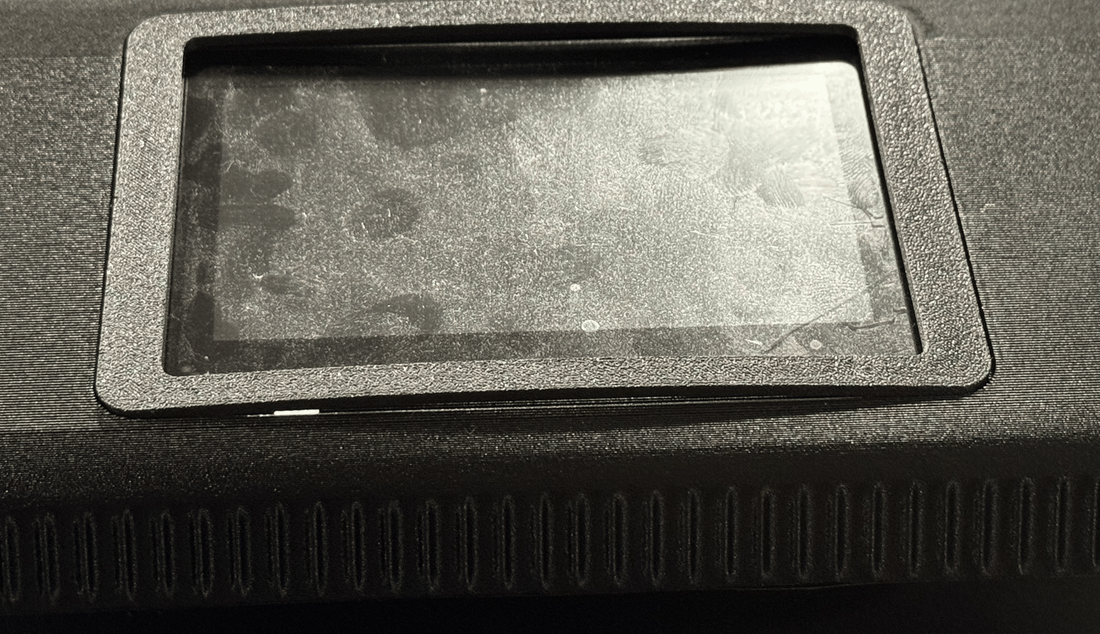
Front-top changed shape on 19 September. The flat 45° face the machine display sat on became a sweep — a curve off the front wall, a 30° plane for the display, a curve onto the roof — and curves like these now print in fine layers all the way through, so they come off smooth rather than stepped. The display sits under a flush cover that snaps in with no screws. The first cover bowed about 0.16 in once its snaps engaged; four trial prints since have moved the snaps inward, and the bow is now slight, though the cover does not yet stay put. Each side wall has a handhold at the floor, and the box closes with six screws.
The faucet, the pumps and the tees
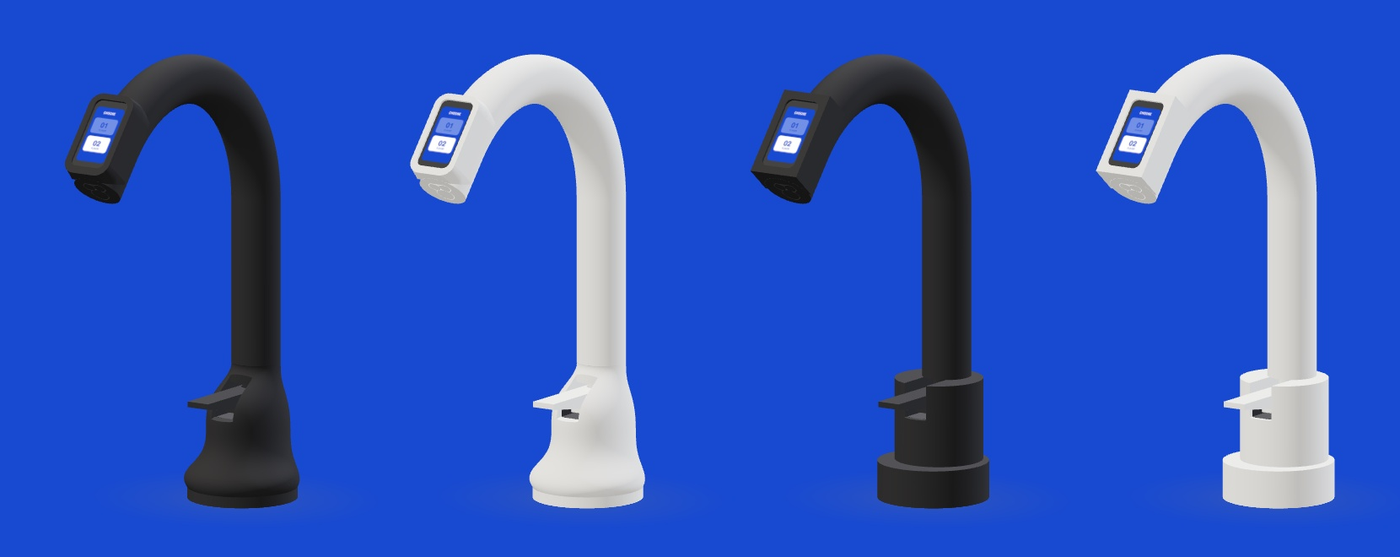
The faucet shell — the printed cover that wraps the bought faucet and its flavor tubes — comes in two styles, Sculpted and Industrial, which share a tip, a joint and their mounts, each in black or white. The white Sculpted shell printed on 18 September as one plate of four parts in about four and a half hours, and black Industrial and Sculpted shells went on the printer the next two nights. The faucet display's cover springs onto the tip with no fasteners, and a printed copy of the faucet's own lever, rebuilt from a 3D scan, passed on the 20th.
The two flavor pumps now slide out of the front as one pump cartridge, without taking a quadrant off the box. Pulling it presses all four tube collets on the way out, and its cord unplugs at a jack. An earlier print held both pumps with no play, and the whole cartridge printed on 21 September; connecting and releasing the tubes through it is the next test. The pumps themselves are now Kamoer KPHM600s, since the KPHM400 stopped being available.
The part that holds the four tees beside the pumps went the other way. A spring tray, a two-piece carrier with squeeze grips and a stiffened web were all deleted on 22 September for a clean start, and the same evening it came back as one plate: a strip of PET-GF through both front flanks, with the four tees tied to it and four springs pushing it back. Pulling the pump cartridge draws it forward just far enough to press every tee's collet. It printed on the 24th; its rounded lower edges curled, and the latest print is good enough to carry on with.
Carbonation, and the funnel
The carbonator changed how it carbonates. Water now comes in through a 1/16-inch hole in a stainless cap on the top inlet and sprays through the CO2 above the water line, and the stone that bubbled gas up through the water is gone. The diaphragm pump that feeds it is now a G Ganen, rated to 110 PSI; the old pump's published curve ran out of flow at 100. The jet's parts arrived on 17 September but it has not been made yet, and the new pump has been scanned but not run.
Two days after the last entry, the funnel's two bench documents came off the drawings shelf. On 19 September the funnel itself grew to 20.3 fl oz, with its outlet centered. The mold for that funnel is sliced but not printed, and nothing has been cast yet.
A face
On 15 September the project got a new mark: a pale faucet with an orange drop, on cobalt blue. It replaced the pink glass on dark navy, and it is now wherever the machine shows itself — this site, the app icons, the guide covers, the YouTube channel, the boot animation on the machine display, and the nameplate.
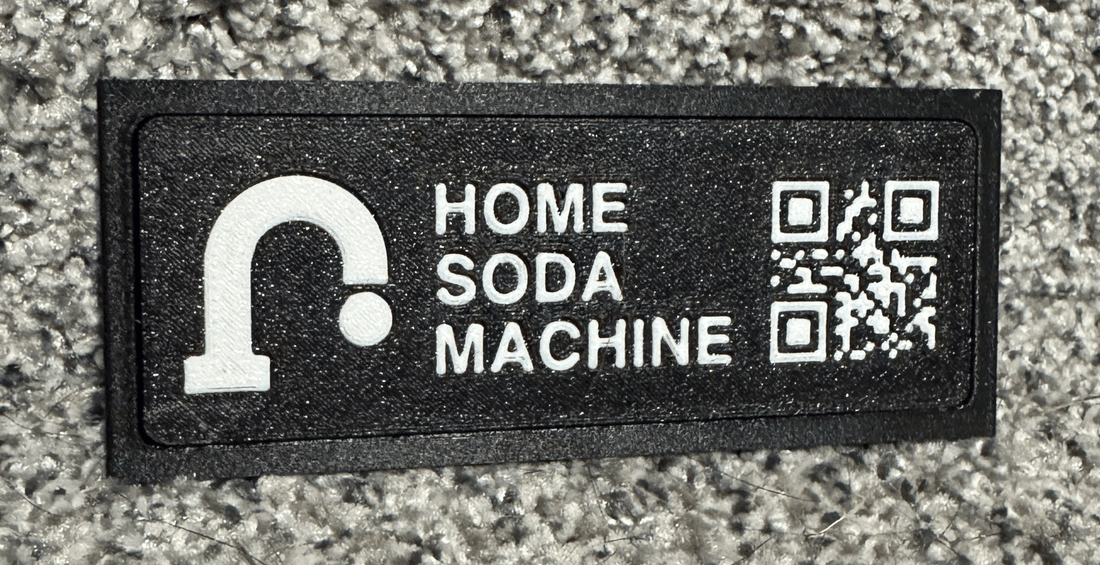
The nameplate carries the mark, the name and a QR code for HOSM.US/0001, short enough for the smallest QR code there is. It scans cleanly from 2 ft. That address opens the unit's own page, with a get-started checklist and the install's seven steps, each linked to its page in the install guide.
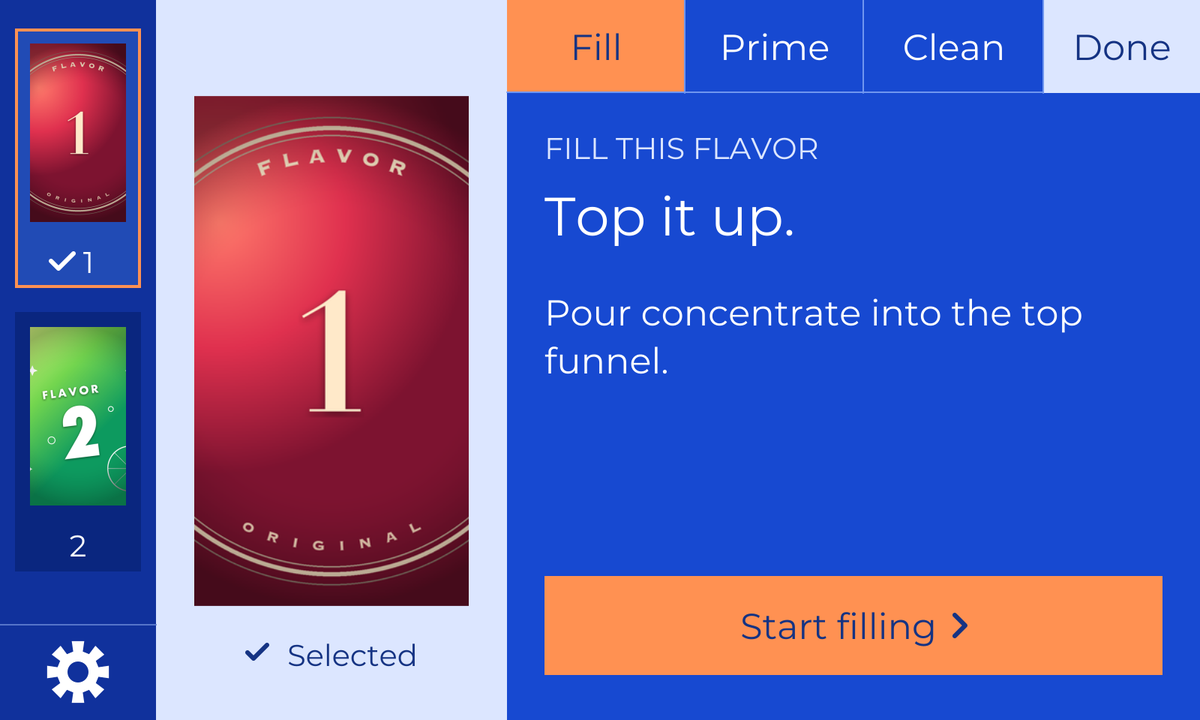
The machine display wears the new colors too. Its home screen, On tap, shows the selected flavor's level, with its pour ratio a tap away and adjustable from 1:6 to 1:24, and Settings opens on a side view of the machine with its ten reed switches reading live. Each flavor can wear one of eight pictures on the machine display and the faucet — four built in and four of the owner's own, cropped on a phone to the shape of the faucet's glass.
On the bench
The phone app can now update every board in the machine: from an iPhone over Bluetooth to the faucet display, then by wire to the main board and on to the machine display. It worked end to end on the bench boards, and between 17 and 21 September it was made dependable. It offers only a build newer than the one installed, a single lost frame costs well under a second instead of stalling the update, and it reports done only after reading the new versions back.
The main board now runs the machine's jobs: filling a flavor, cleaning, drying before a pump swap, the pour itself with pump speed following the flow meter, a self-test, and the cold loop that holds the carbonator between about 36 and 39 °F with a freeze cutout. All of it has been walked through on the bench with simulated readings. None of it has run with water, a temperature probe or the compressor.
For the buyer
The install guide is now a printed book: 24 saddle-stitched pages, 6-5/8 × 10-1/4 in, in the new colors, walking the same seven numbered steps as a single quick-start sheet. Three copies were ordered on 16 September and have not arrived. The install cuts no tubing, and it hands no step to anyone else: the buyer fits the CO2 regulator to the cylinder and checks it by ear and with soapy water. The regulator's tube ends in gray, CO2-rated fittings that go on by hand.
The shop
The weld rotator is built: a printed turntable that stands the 5-inch stainless carbonator tube upright and turns it under the hand-held laser welder for as long as a foot pedal is held down. It went together on the welding table on 11 and 12 September and turns under the pedal; nothing has been welded on it yet. Its 48-page build guide is on the drawings shelf.
A 3D scanner arrived on 18 September. In ten sessions since, it has measured most of the bought parts the machine is built around — the tees, a valve, the flow meter, both kinds of pump, the tube ends, the power inlet and the CO2 regulator — and the faucet lever above came from it. A scan now sets a part's shape, while calipers and prints that already fit set its fits. The valve came out a little longer than its drawing, which reopened five clearances inside the box.
Films, and the site
Two films went up on 25 September. Cold Soda on Tap — Inside a Home Soda Machine is a narrated three-minute tour through the machine's own model, from the water supply through the cold core to the pour. One Less Errand is a 100-second animated short about the trip to the store a glass of soda should not need; it now plays on the home page, under the sign-up form.
The walkthrough page the tour was cut from is retired, and every section of this site — Parts, Charts, Drawings, Boards and Cost — is now in everyone's navigation. In Parts the faucet can be viewed in either style and either finish.
What one costs
The parts for one machine now come to $1,374.74, up from $1,329.97 at the start of the window. The cold core's shell and caps moved to glass-filled PET, and the flavor pump pair cost more once the KPHM400 was gone; the new diaphragm pump and the jet cap cost less than what they replaced. Building one takes 10 h 15 m of hands-on work and 164.8 printer-hours, about 15 lb of filament.