A mold for the funnel, and the half hour it gives you
The funnel is the one part of this machine that is cast rather than printed, and it now has tooling, a finishing process measured on its own coupon, and two bench documents on the drawings shelf.
The funnel is the thing a flavour bottle is poured into — it sits in the top wall, lifts out by its brim for the dishwasher, and drains to a quarter-inch spout. It is silicone, so it is the one part of this machine that is cast rather than printed, and until now the only thing describing how to make one was a section of the mold's README.
It is a 6 mm shell. One pour is about 135 mL including a tip that gets cut off, which is roughly 153 g of platinum silicone, and a kit makes about seven of them. The spout's bore is not moulded by anything printed: a ground steel dowel, 6.35 mm and held to a ten-thousandth of an inch on diameter, stands in the cavity and the silicone closes around it.
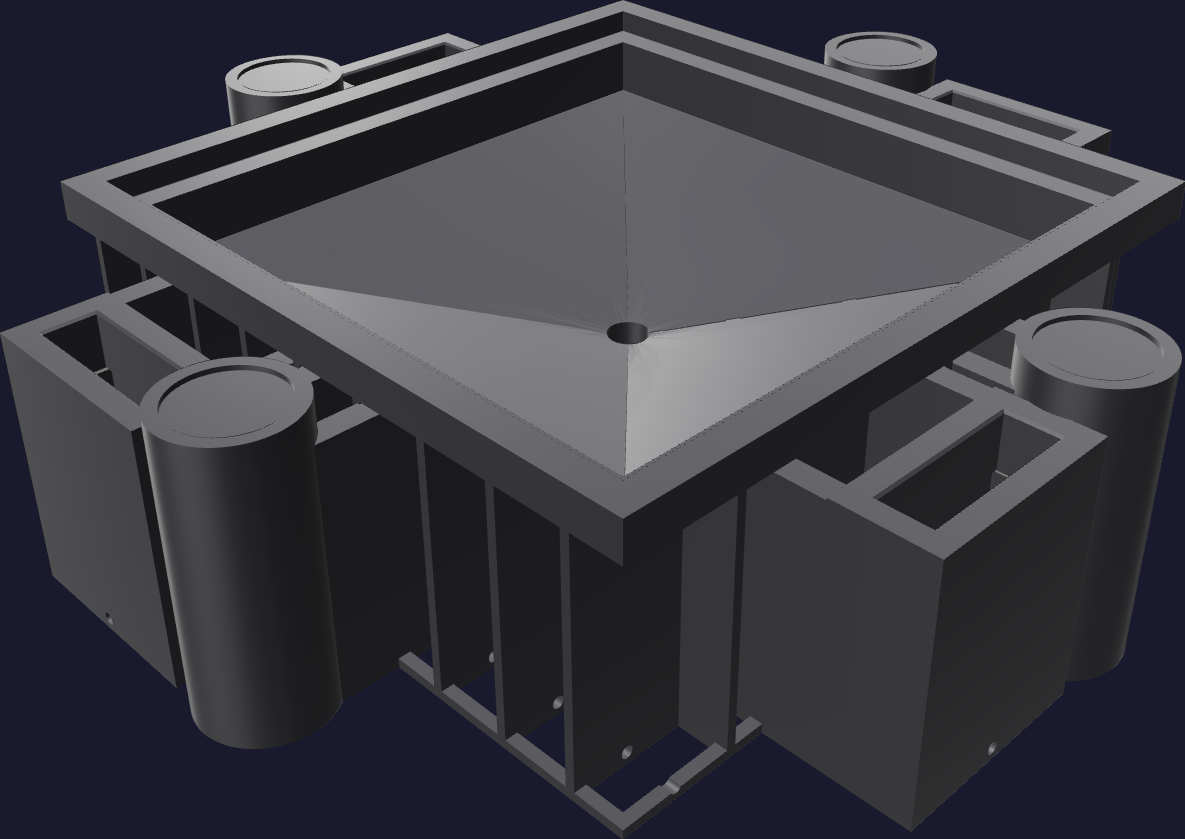
The mold is two prints and a finishing process
Two PETG halves, 270 mm square. The cavity forms the outside and is poured into; the core forms the inside and drops onto it. Three plates: a two-hour plate of coupons first, then 37 hours of cavity and 31 hours of core, 2.35 kg of filament across the three.
The coupons are the reason the two long plates can be started at all. They reproduce, at full size and in the real print orientation, every fit the big parts depend on — the square-nut slot with its bridged retaining lip, a guide bearing, a washer pocket, and the same 17.6 mm bridge span the forming skin crosses over every rib bay. A tight fit is corrected on a two-hour print rather than discovered after sixty-nine.
Neither forming face is printed to size. Both are printed 0.20 mm away from the funnel — the cavity grown, the core's plug shrunk — and finishing puts that thickness back as coating. The mold is only the right size once it is coated, and a film of 0.20 mm closes an internal width by 0.40. What measures that is the third coupon: a flat strip between two rails standing exactly one allowance proud, so a straightedge across the rails reads the growth directly, and a ramp cut at the funnel's own floor grade to say whether the same process takes the layer terraces off a slope without rounding its transitions.
Getting the core off again
The cured part grips. Four M5 screws lift the core: each passes through a square nut captured in a printed arm and rests its tip on a steel washer sitting in the cavity, so turning one down cannot push the washer anywhere and the core rises instead. A quarter turn is 0.20 mm. The working lift is 32 mm, which is forty full turns on every screw, taken in opposite-side pairs.
Three numbers meet at that 32 mm, and their order is the whole design. The rod socket is 28.8 mm deep, so a stationary rod is out of the core before anything else happens. Twelve millimetres of guide blade are still in their bearings, so the core is still held square. And four shallow marks on the outsides of the blades come level with the bearing mouths, which is how the lift is read. The spout casts twelve millimetres past its finished length and a 1 mm step at the true exit gives the trimming blade something to index on; everything below that step is scrap.
Two documents
Both are on the drawings shelf. The first builds the tooling — the three prints, the fits to check, what gets coated and what must stay bare PETG, and the four steel stations. The second is the one you take to the bench with gloves on, because mixed silicone runs on a clock: thirty minutes of working time at 23 °C, and five hours to demold. Weigh, mix, degas the cup, pour the open cavity, lower the core, pull one more vacuum on the filled mold, top it up while it still flows.
The silicone's own figures now stand beside the mold rather than in a supplier's listing, including the two places that listing contradicts itself and the one thing it does not say at all: there is no post-cure schedule. The bake is the food-contact gate, so it is the project's to establish, and the only number the maker gives that bounds it is the cured rubber's 230 °C ceiling.