A word at both ends of every line
Every tube that crosses the rear wall now carries a coloured, lettered chip at the wall, and the same word in the same colour threaded onto the tube itself.
Five lines cross the rear wall: tap water, carbonated water, CO2, and two flavours. Each crossing carries a port ring — a flat printed chip lying in a pocket cut into the wall's outer face, under the through-wall fitting's own flange. The pocket is the chip's own 2 mm deep, so colour and wall come out one plane, and the fitting's nut draws flange, chip and wall together.
The outline is a D on its back. A half circle below the bore's axis, which is the shape the port itself is, and a rectangle above it, which is where the word goes. It takes its pocket one way up and no other.
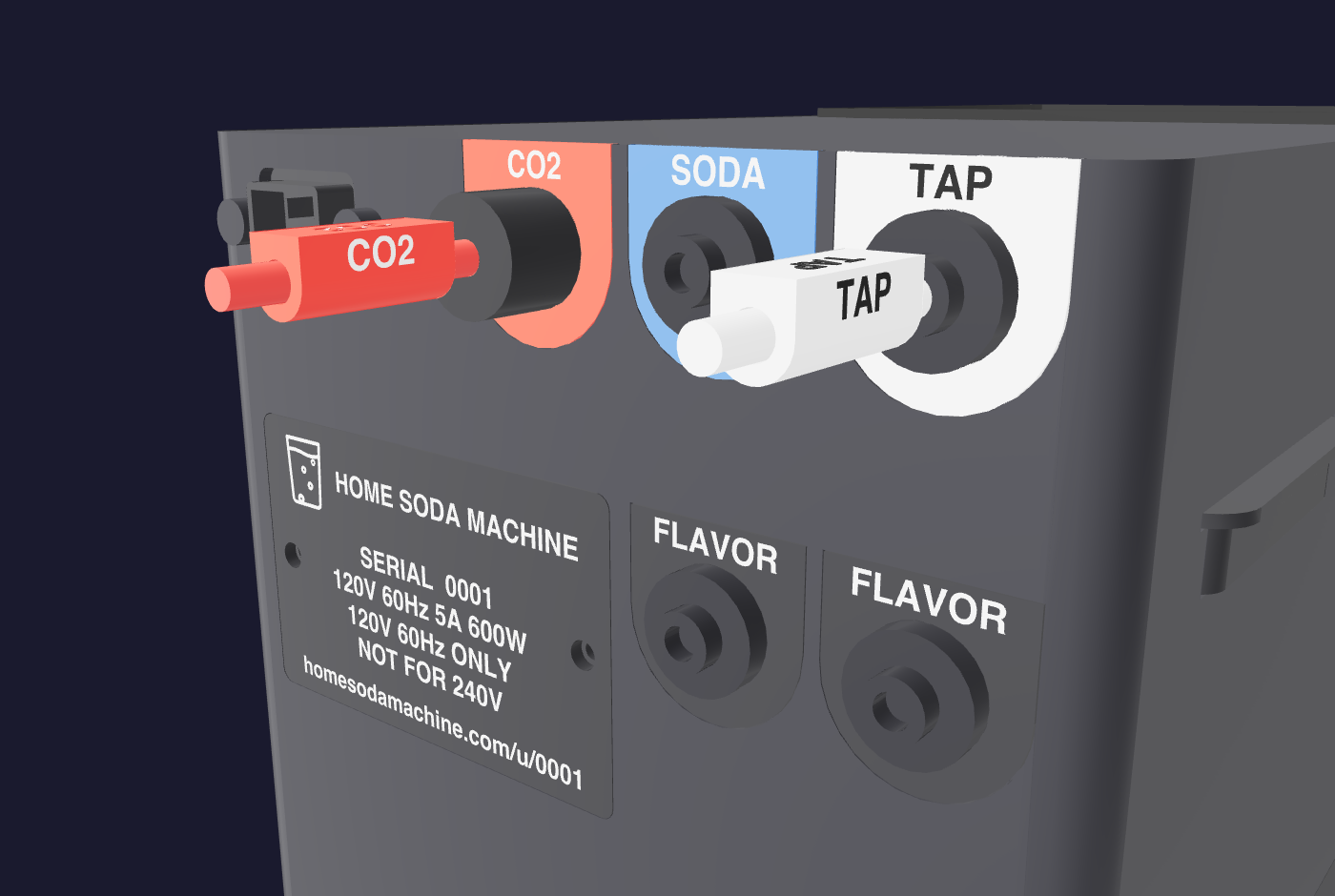
A chip's colour is the colour of the tube that goes into it — white for tap water, blue for the carbonated-water riser, red for the customer's regulator tether, black for both flavours. The word is a second solid in a second colour, lying in a 1 mm recess in the chip's outboard face and filling it flush, set in Helvetica bold at a 4.951 mm cap: the face the build deck and the customer's quick-start sheet are already set in. The chip opens as one part carrying both bodies, with the lettering assigned the second filament.
What the lettering runs out of first is not the stroke but the bridge of chip left standing between two letters — 0.346 mm at FLAVOR's L and A, against a 0.22 mm bead laid through a 0.2 mm tip.
Every chip's rectangle rises 18.789 mm over its own bore, so a chip is one height wherever it stands and every word is lettered in the same band. On the top row that rise carries the chip out onto the wall's top face, fenced left, right and below, open above.
Both flavour stations wear the same black chip and the same word. A customer pushes black into either one and the manifold sorts them, so nothing on that face tells A from B.
The same outline, threaded onto the tube
The same outline, bored for the tube instead of the fitting's barrel and run 30 mm along it, goes onto the line itself.
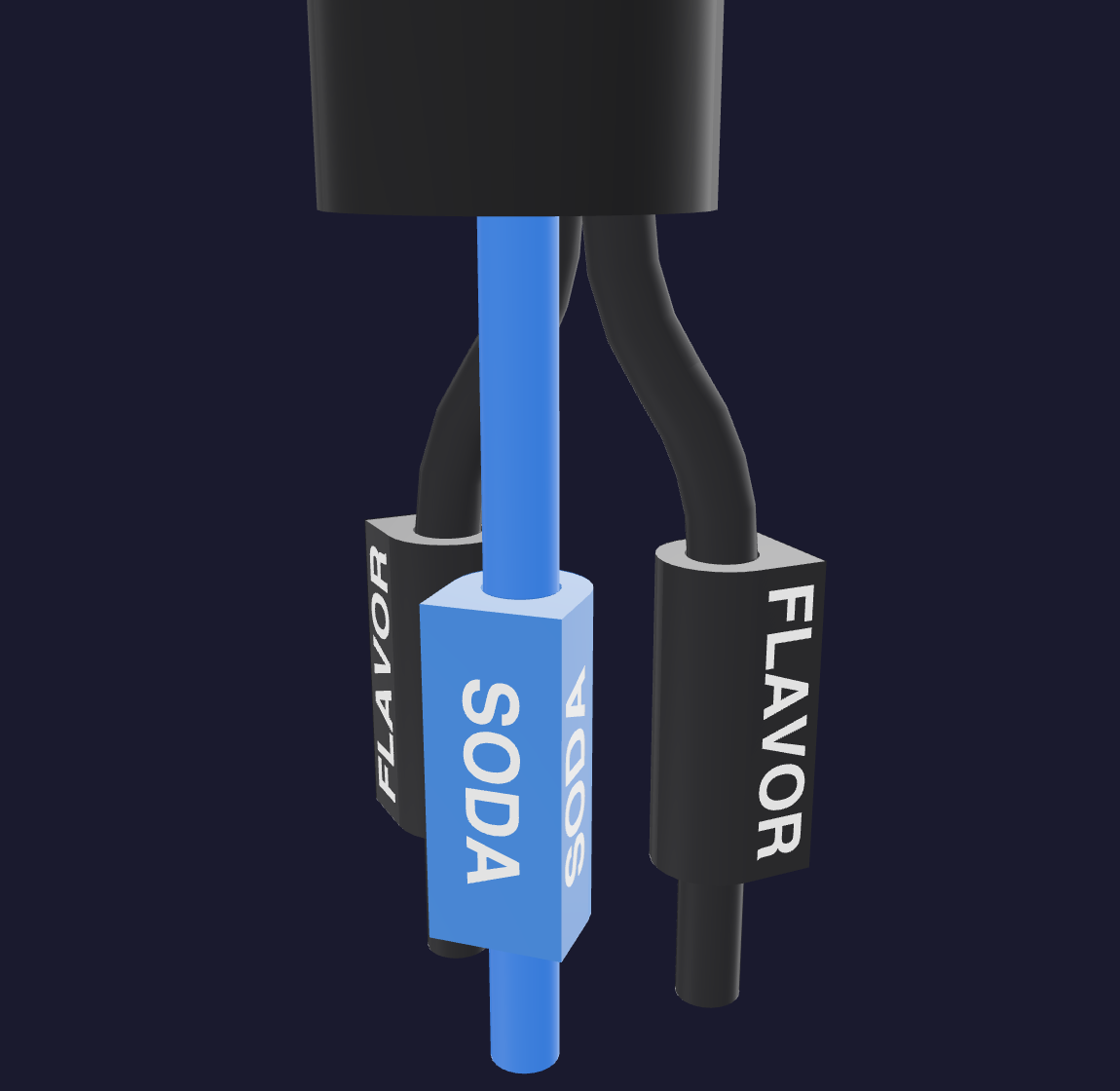
One collar per chip, on the same five stations, off the same five words. Three go on at the bench — SODA on the blue tube, FLAVOR on each black one — run up the bare tail until they butt the braid's own end, and turned so no two flags face each other. The other two, TAP and CO2, ship in the install kit for the two runs the customer cuts in their own kitchen.
The flag stands 7.05 mm over the tube's axis, which is the band of colour a chip shows past its fitting's flange, and the word is set at the chip's own cap height. One typeface, one size, one colour per line, at both ends of it.
The bore is sized off the biggest tube a spool runs rather than off the nominal. The extrusion is held to about 0.13 mm; Ø6.73 mm goes to the slicer, the bore's unsupported crown sags and the printer takes 0.1 mm off the diameter, and Ø6.63 mm comes off the plate — 0.15 mm of slip on the fattest tube it will ever meet, 0.41 mm of play on the thinnest. It threads on by hand, end-first, over a tail that is still bare.
Nothing clamps it. What holds a collar is the bend the tube came off the spool with: 1/4" LLDPE is never straight through 30 mm of bore, so it stands against the wall at both ends of one and stays where it is put. That play is 0.78° of cock, and 96 µm at the flag's own face. The same play on a chip's 2 mm of thickness is 11.59°.
The em, how far the word stands past the face, and how deep its recess is cut were each put to a printed plate of six chips, one proposal to a chip. The word stays flush. The plate, and the case each chip was cut to make, are kept under a tag.